Baby socks: how to choose them well at every stage
Size, fabric, cuff and non-slip sole: this is how to choose baby socks so they don't fall off, don't pinch and don't slip around the house.
Socks are one of those purchases we make almost without looking. A pack of three, the colour that goes with the bodysuit, and home we go. Until you discover that one falls off every ten minutes, another leaves a mark on the ankle, and the third always ends up under the sofa.
The truth is that choosing well isn’t very mysterious, but there are a few details that make a difference. Brands with a long track record in children’s fashion, such as www.condor.es, have been making socks for little ones in Arenys de Mar for over a century, and you learn something by looking at how they make them. Let’s get to it.
Why it’s worth paying attention
A baby’s feet are not simply small adult feet. They have more cartilage than bone, they move a great deal and they sweat more than we imagine. A sock that pinches or doesn’t breathe isn’t just uncomfortable: it can irritate the skin and bother the little one just as they’re discovering their own toes.
And then there’s the thermal side. Newborns don’t yet regulate their temperature well, so in the first months the sock serves a far more serious purpose than looks.
What to check before buying
Size, by age and not by eye
This is the most common mistake. We buy “so they’ll grow into them” and the heel ends up halfway across the foot. It’s best to follow each manufacturer’s size chart, which usually goes by months in the early years (0-3, 3-6, 6-12…). If you’re torn between two sizes, check whether the model has a reputation for running large before deciding.
Fabric
For everyday use, cotton is king: soft, breathable and it survives washing without complaint. When the cold arrives, extra-fine wool or thicker cotton keeps them warm without itching. A small percentage of elastane or Lycra helps the sock adapt to the foot and not lose its shape. And if your little one’s skin is delicate, look for the Oeko-Tex label, which guarantees the fabric contains no harmful substances.
The cuff
This is the key to them not falling off. A ribbed cuff holds without squeezing; if you see a red mark on the ankle when you take it off, it’s too tight.
Non-slip, once they start standing
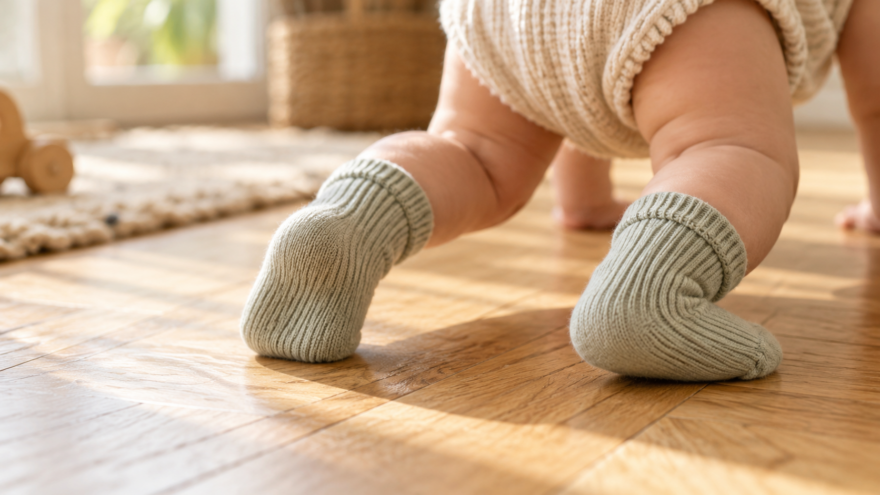
As soon as the baby crawls or takes their first steps around the house, baby socks with a non-slip sole give them security on parquet floors or tiles. I can assure you it shows in the number of bumps and tumbles.
According to season and stage
- Newborn (0-3 months): soft, high socks with no prominent seams at the toe. They spend a lot of time lying down, and a longer sock also protects the ankle.
- Autumn and winter: warm cotton, fine wool or tights if they’re in the pram. Two thin layers are better than one very thick one that doesn’t let the toes move.
- Spring and summer: fine or openwork cotton, and at home, barefoot whenever possible. Walking without anything on helps strengthen the foot.
- First steps: non-slip socks for indoor use and, once they’re wearing shoes, a sock that doesn’t bunch up inside.
A tip that never fails: buy several identical pairs. When one disappears (and one will), the other still has a partner.
The essentials, in a nutshell
There’s no need to overcomplicate things. Correct size, natural fabric, a cuff that holds without squeezing, and a non-slip sole once they start moving. With that you’ve covered 90% of the way. The rest, colours, prints or that little bow grandmas love so much, is a matter of taste. And there, honestly, each family makes the call.