Board Games vs. Video Games: What Each One Brings to Child Development
We compare what board games and video games develop in childhood, with age-based recommendations and guidelines for balancing them at home without guilt.
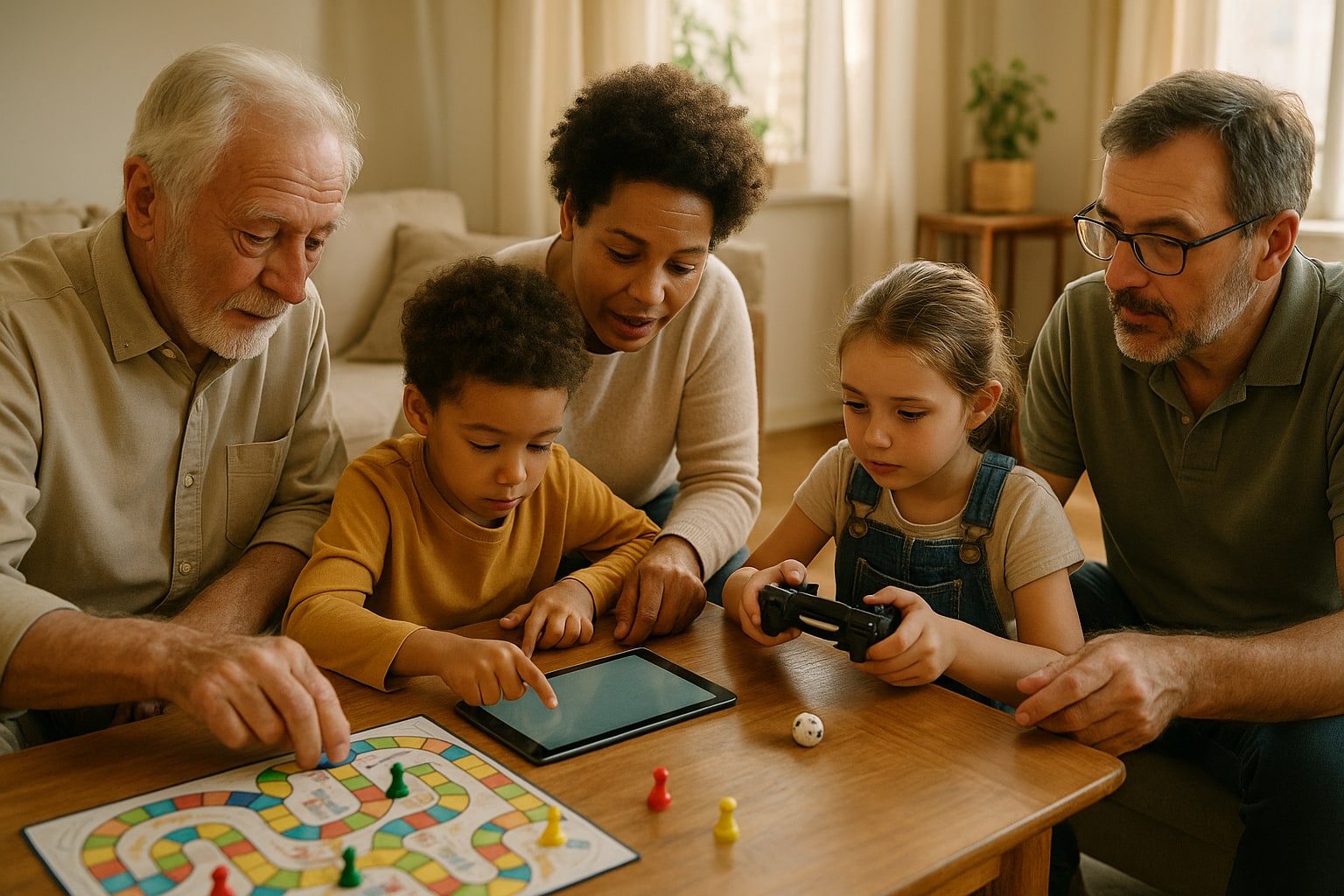
If your home has Parcheesi, UNO and a console, you’ve probably wondered at some point whether one is “better” than the other for your kids. The short answer: they’re not enemies. The long answer, which is the one you care about, has nuances depending on age, type of game, and how you accompany them from the sidelines.
This article is for families with children aged 3 to 14. We’ll tell you what the evidence says about each format, which skills each one trains best, and how to fit them into the week without the living room turning into a battlefield.
What each format offers in 30 seconds
Before going into depth, here’s a quick table to give you an idea of where things stand.
| Aspect | Board games | Video games |
|---|---|---|
| Face-to-face social interaction | High | Variable (depends on the title) |
| Reflexes and quick visual attention | Low | High |
| Frustration tolerance | High (losing in person) | High (retrying levels) |
| Reading, mental arithmetic, strategy | High | Medium-high |
| Risk of excessive use | Low | Medium-high |
| Cost per hour of play | Medium | Low (once purchased) |
| Recommended minimum age | From 2-3 years | From 5-6 years (very occasionally) |
Neither wins. Each one trains different things, and the interesting part is combining them.
Why board games remain powerful
A board game forces you to look each other in the face. To wait your turn. To put up with having your piece eaten without flipping the board over. That, which seems minor, is a very dense emotional and social training.
The Spanish Association of Paediatrics (AEP) reminds us that shared family play is one of the great allies of child development, especially in the early years. When you play dominoes with your 5-year-old daughter, you’re working on language, working memory, pattern recognition and bonding, all at once.
Cognitive and language skills
Board games that require reading cards, counting spaces or planning moves train executive functions: planning, memory, sustained attention. In children aged 6 to 12, studies published in journals such as Developmental Psychology have linked strategy games (chess, checkers, games like Catan Junior) with improvements in logical and mathematical reasoning.
With younger kids, cooperative games such as “the fruit tree” or “the enchanted forest” work on vocabulary and joint decision-making, without the pressure of “winning”.
Social and emotional skills
Losing face to face hurts more than losing an online match. And that, when well accompanied, is gold. Learning to manage frustration, to congratulate the other person, to negotiate rules, is a learning that isn’t achieved the same way in front of a screen.
What video games offer (yes, also good things)
For years, video games were discussed only in terms of risk. Recent evidence is more nuanced. Moderate use appropriate to age can bring real benefits to children’s cognitive development.
Visual attention, reflexes and problem solving
Research from the University of Rochester and publications in Nature have shown that action video games improve selective visual attention, processing speed and the ability to switch between tasks. Puzzle games (Portal, Monument Valley, Tetris) train spatial reasoning.
Minecraft, to mention a classic, works on planning, creativity and geometry more intensely than it may seem from the outside. If you want to dig into specific titles, we have a guide on video games for children aged 6 to 12 and what to look out for before buying.
Social skills in the digital environment
Many online games are cooperative. Playing with cousins at a distance, coordinating as a team, sharing roles… that is also socialising. It doesn’t replace face-to-face contact, but it adds to it, especially in pre-teens.
Frustration tolerance
A video game makes you repeat the same level twenty times. That, handled well, teaches perseverance. Handled badly, it ends in a tantrum and a controller flying across the room. It depends heavily on the title and the accumulated time.
What board games do better
- Direct family bond. Nobody looks at a screen; you look at each other.
- Oral language. You negotiate, argue about rules, laugh together.
- Live emotional self-regulation. Losing in front of your brother is a masterclass.
- Zero overstimulation. The pace is set by the table, not by an algorithm.
- Accessibility. You don’t need wifi or a software update.
What video games do better
- Visual attention and reflexes.
- Complex spatial reasoning (especially 3D and building games).
- Intrinsic trial-and-error motivation (levels hook you by design).
- Long-distance play with cousins, school friends or relatives who live far away.
- Accessibility for children with motor difficulties or specific sensory needs, with adapted controllers.
How to balance both at home
There’s no magic formula, but there is a framework. The WHO and the AEP recommend limiting total recreational screen time: none before age 2, less than 1 hour a day between 2 and 5, and “reasonable and supervised” time from age 6, prioritising sleep, physical activity and relationships. You’ll find the details in our article on screen time by age according to the WHO and the AEP.
Some ideas that work in many homes:
- A set afternoon each week for board games, even if it’s only 20 minutes. If it’s a fixed day, it becomes routine and nobody protests.
- Video games with a clear schedule, not “until you finish the level” (because it never finishes).
- Play their video game too. Ten minutes with the controller will tell you more about what they’re doing than a thousand conversations.
- Choose cooperative titles, both board and digital, to reduce conflict.
Age recommendations
| Age | Recommended board games | Video games |
|---|---|---|
| 3-5 years | First cooperative games, memory games, bingo, large dice | Not recommended as a rule. Very occasional and supervised use |
| 6-8 years | Dominoes, UNO, simple strategy games, Dobble | Puzzles, gentle platformers, PEGI 3-7 titles, with limited time |
| 9-11 years | Chess, Catan Junior, Carcassonne, light role-playing games | Creative Minecraft, sports games, adventures PEGI 7-12 |
| 12-14 years | Complex strategy games, deduction, party games | Supervised cooperative multiplayer, PEGI in line with age |
Remember that the PEGI rating is indicative but useful. It’s not an industry whim: it flags content unsuitable for violence, language or integrated purchases.
Common mistakes and myths
“Video games make children aggressive.” Current evidence doesn’t support a clear causal relationship between video games and aggression in healthy child populations. The type of content, the amount of use and the family context do have an influence.
“Board games are ‘educational’ and video games are not.” False in both directions. There are pure chance board games that develop almost nothing, and video games that intensely train logic, creativity and cooperation.
“If they play alone, they don’t socialise.” It depends. A child who plays online with their cousins is socialising. The issue is when it completely replaces in-person play, which is indeed worth avoiding.
Frequently asked questions
At what age can I introduce board games?
From 2-3 years with very simple matching games or dice rolling. What matters is that sessions are short and the rules minimal.
Are educational video games better than entertainment ones?
Not necessarily. Many “non-educational” games train powerful cognitive skills. The useful criterion is: content suited to age, limited time and, if possible, shared play.
My child prefers video games to board games. Am I doing something wrong?
No. Video games are designed to hook more than a board does. The strategy that works in many families is to propose board games at specific times (dinner, after-meal chat) rather than as a competitive alternative to console time.
Can I use video games as a reward or punishment?
You can, but make it a stable rule, not a daily bargaining chip. If video games become “the prize”, their emotional value skyrockets and it becomes harder to regulate.
And what if there are two adults at home who don’t agree on the criteria?
Talk about it without the kids present and agree on a common framework (hours, days, permitted titles). Children spot cracks quickly, and that’s where conflicts appear.