Screen addiction in children: real warning signs and when to consult a professional
Telling excessive screen use apart from a genuine addiction is not easy. Here are the signs that professionals do take seriously and when to ask for help.
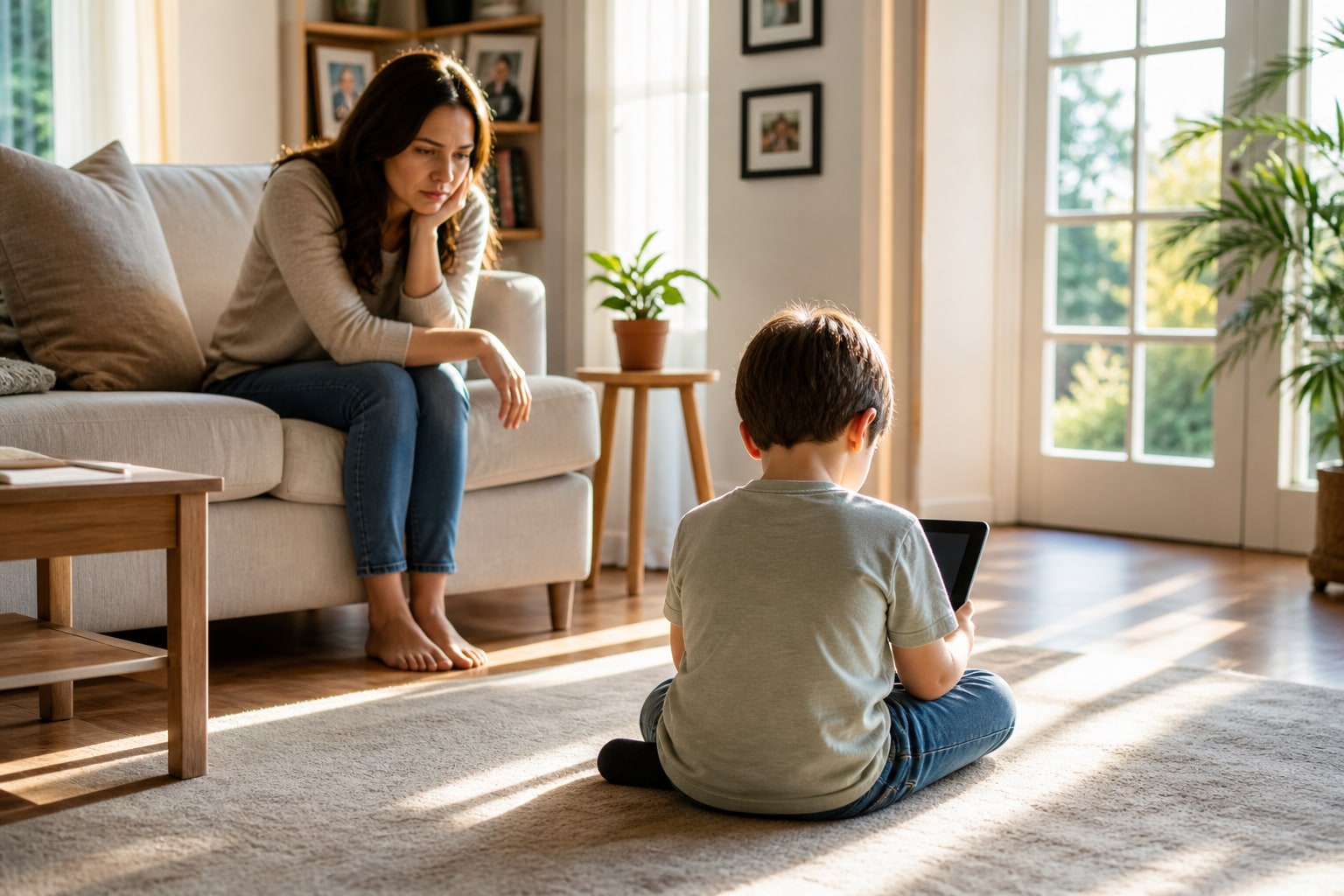
There are days when the tablet is the only thing that lets you shower in peace, finish a video call or make dinner without your little one climbing onto the kitchen counter. That doesn’t make your child an addict. It doesn’t make you a bad parent either. But there is a point where screen use stops being a tool and starts interfering with sleep, mood, studies or relationships. That’s when it’s worth stopping to take a closer look.
This article is a guide for families with children aged 2 to 14 (and teenagers). We’ll help you tell excessive use apart from a real addiction, identify signs that can be observed at each age and know when it makes sense to consult a professional. No alarmism, just the criteria used by the WHO, the Spanish Association of Paediatrics (AEP) and the American Academy of Paediatrics (AAP).
Excessive use is not the same as addiction
This is an important distinction and it is often blurred. A child can spend too many hours in front of screens without meeting the criteria for addiction. And the reverse is also true: a teenager may have an apparently moderate amount of screen time but an emotional dependence that does fit a genuine problem.
The WHO recognises gaming disorder in the ICD-11. The clinical criteria require the pattern to persist for at least 12 months and include three features: loss of control over use, growing priority given to gaming over other activities, and continuation or escalation despite negative consequences. For screens in general (social media, short videos, streaming) there is not yet an official diagnostic category, but similar criteria are used.
In practice, excessive use is corrected by adjusting rules and routines. An addiction requires professional support because there is an emotional, behavioural or even neurobiological component that the family alone cannot undo.
Recommended screen time by age
A quick framework for reference, based on the recommendations of the WHO and the AEP. You can explore this topic further in our guide to screen time by age according to the WHO and the AEP.
| Age | Recommended screen time | Notes |
|---|---|---|
| 0-2 years | 0 minutes | Video calls with family only |
| 2-5 years | Max. 1 hour/day | Quality content, supervised |
| 6-12 years | 1-2 hours/day of leisure | Outside school time |
| 13-14 years | Agreed limits | No screens in the bedroom or during meals |
These ranges are indicative. What matters is not timing it to the minute, but what the screen is displacing: if your child sleeps, eats, moves and socialises, you are within a reasonable range.
Warning signs by age
The signs that concern professionals are observable and fairly concrete. They go beyond “they’re on the phone a lot”.
Between 2 and 5 years:
- Intense, disproportionate tantrums when the screen is taken away, beyond normal protest.
- Loss of interest in free play, movement or books.
- Difficulty falling asleep without background videos.
Between 6 and 12 years:
- A clear drop in school performance with no other cause.
- Lying about how long they have been online.
- Withdrawing from face-to-face friendships in favour of digital ones.
- Marked irritability when disconnecting.
In adolescents (12-14 years and older):
- Secret night-time use that affects rest.
- Anxiety when unable to access the phone (even for a few minutes).
- Giving up activities they used to enjoy (sport, music, meeting friends).
- Changes in appetite, weight or mood.
- Comments of hopelessness or self-deprecation linked to social media use.
The occasional appearance of one of these signs does not mean anything serious. What is worrying is a combination of several, sustained over time and with a real impact on the child’s or teenager’s life.

Effects of screens in childhood
Current evidence, collected in studies published in JAMA Pediatrics and Pediatrics, points to associations (not always direct causation) between excessive use and:
- Poorer sleep quality, above all due to blue light and emotional arousal before bedtime.
- Lower academic performance when recreational use regularly exceeds 2 hours a day.
- Greater sedentary behaviour and an associated risk of overweight.
- Symptoms of anxiety and low mood in older adolescents who are heavy social media users, especially girls.
- Attention difficulties with very high consumption of fast-paced content (short videos).
None of this is destiny. These are statistical trends that can be corrected when use is adjusted.
When to consult a professional
This is the key question. There are fairly clear thresholds for seeking help from a paediatrician, child psychologist or child psychiatrist:
- When screen use interferes persistently (for more than 4-6 weeks) with sleep, studies, eating or relationships.
- When you try to remove or limit it and disproportionate reactions appear (aggression, uncontrollable crying, threats) that do not calm down over days.
- When there are repeated lies about use, or secret use at night.
- When the child or adolescent expresses distress about their own use (“I can’t stop”, “I feel bad when I put it down”).
- When signs of low mood, anxiety or thoughts of self-harm linked to social media or online content appear.
The first step is usually the paediatrician, who will assess whether to refer to child and adolescent mental health services. In cases of suicidal ideation or self-harm, the 024 helpline is available 24 hours a day.
What you can do at home
Before thinking about a diagnosis, many families improve the situation with changes to routines:
- Screen-free zones and times: meals, short car journeys, bedrooms at night.
- Charge phones outside the bedroom, yours included. Example matters.
- Disconnection time at least 1 hour before bed.
- Appealing alternatives: sport, meeting friends, board games, cooking as a family, outdoor plans.
- Accompaniment, not surveillance: watching together what they consume, asking without judging.
- Parental control tools suited to their age and reviewed regularly.
If you have a teenager, the approach changes. Imposing without negotiating usually gives worse results than agreeing clear limits. Our guide on how to negotiate phone use with teenagers may help.
Common myths
“If they use screens, their brain will atrophy.” No. The evidence points to associations with sleep, attention and mood, not to irreversible neurological damage.
“Video games are always bad.” It depends on the content, the time and the context. Many games develop planning, cooperation and problem-solving skills.
“If I don’t give them screens, they’ll fall behind.” Digital literacy is acquired quickly in adolescence. Early exposure is not necessary.
“My son is addicted because he plays for 3 hours a day.” Time alone does not define addiction. What matters is the impact on the rest of his life.
Frequently asked questions
How can I tell if my child is addicted to their phone? Look at the impact, not just the hours. If they sleep, eat, study, socialise and reasonably accept limits, there is probably no addiction, even if their use seems high to you.
At what age can we talk about addiction? The WHO’s clinical criteria for gaming disorder require a pattern lasting at least 12 months. In children under 10-12, it is more accurate to speak of problematic use than of addiction as such.
Is taking the phone away suddenly a good idea? Generally, no. It can cause a major conflict without resolving the underlying problem. It is better to reduce use gradually and by agreement, and to seek professional support if there is genuine dependence.
Is parental control enough? It is a useful tool, but not a complete solution. It works when accompanied by family rules, conversation and alternatives. Teenagers, moreover, often find ways around it.
Should we worry about use during holidays? Occasional peaks during holidays or weekends are not a sign of anything. What matters is the sustained pattern during the school term.