Screen time by age: what the WHO and the AEP recommend in 2026
An updated guide with the WHO and AEP recommendations on screen time by age in 2026, with specific figures for each age group and practical tips for home.
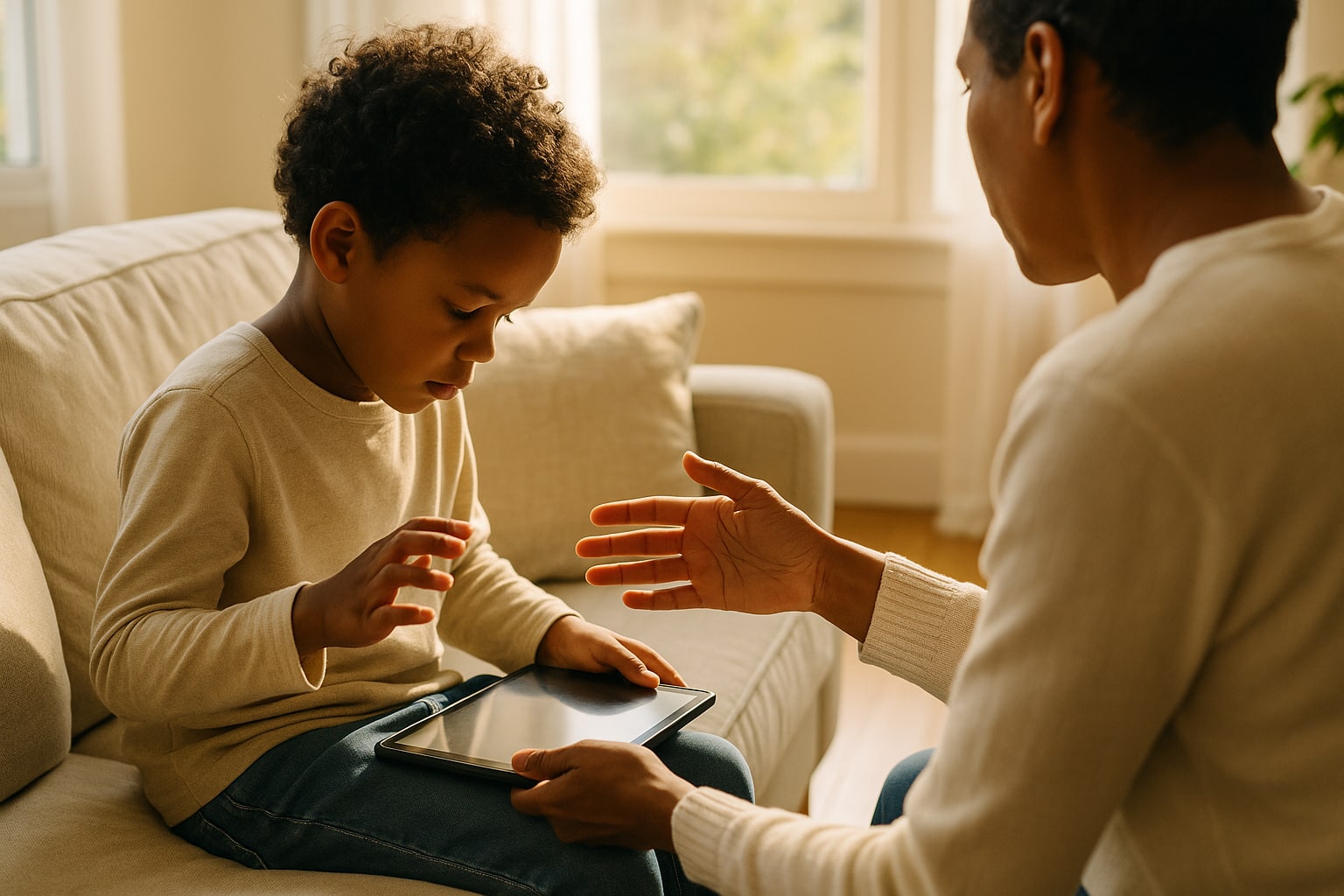
If you have ever handed your phone over at a restaurant so you could finish your meal, welcome to the club. The debate about screen time by age has been going on in paediatric clinics for years, and in 2026 both the World Health Organization and the Spanish Association of Paediatrics (AEP) still set fairly clear lines, although with more nuance than a few years ago.
This article summarises what the current guidelines say, how much time is considered reasonable depending on your child’s age, and what you can do at home without turning every afternoon into a battle.
Why screens worry us (and why it is not all black or white)
Screens are not poison. Nor are they harmless. The evidence accumulated over the last decade suggests that excessive or inappropriate use in childhood is associated with poorer sleep, less physical activity, language delays in children under 3 and greater attention difficulties at school age.
The AEP, through its Family Digital Plan, insists on something important: not all screen time is the same. A video call with the grandparents is not the same as an endless autoplay video. Watching a film together as a family is not the same as leaving a phone unsupervised with a 4-year-old.
That is why current recommendations speak less and less about “exact minutes” and more about what is watched, with whom and when.
Quick summary by age range
Before going into detail, this table summarises the WHO recommendations (2019, still valid in 2026) and the AEP’s most recent update:
| Age | Recommended time (recreational use) | Main source |
|---|---|---|
| 0-2 years | 0 minutes (except video calls) | WHO / AEP |
| 2-5 years | No more than 1 hour a day, the less the better | WHO / AEP |
| 6-12 years | No fixed figure: no more than 1.5-2 h/day, supervised | AEP |
| 13-18 years | Self-regulation with agreed family limits | AEP |
From here on, we go age group by age group.
From 0 to 2 years: zero screens (with one nuance)
The recommendation from the WHO and the AEP is clear: before the age of 2, no passive screen use. No tablet, no phone, no television in the background while the baby eats.
The only accepted use is video calls with family members, because they involve real interaction, emotional response and turn-taking in communication. Seeing grandma on a video call for 15 minutes is not the same as leaving cartoons on.
Why are they so strict? In these months the brain is building language, attachment and motor development through human contact, movement and the handling of real objects. No app can replace that.
From 2 to 5 years: one hour at most, and always supervised
Between the ages of 2 and 5, the WHO recommends not exceeding one hour a day of screen time, and adds an important phrase: “less is always better”.
The AEP is more specific:
- Slow, quality content, without advertising or autoplay.
- Always supervised by an adult who comments on what is being watched.
- Never during meals or in the hour before bed.
- No screens in the bedroom.
In this age range, using the screen as a “digital dummy” to calm tantrums is the point that worries paediatricians most, because it prevents the child from learning to regulate their emotions on their own.
From 6 to 12 years: the “it depends” stage
Here there is no longer a magic number. The AEP recommends not exceeding 1.5-2 hours a day of recreational use, clearly separating:
- Educational use (homework, school research, digital reading): it does not count the same.
- Recreational use (games, videos, social networks): this is what needs to be limited.
- Passive background use (television left on with nobody watching): to be avoided.
This is the age when the first requests for a personal phone, a games console in the bedroom or an account on video platforms appear. The general recommendation is to delay a personal phone for as long as possible, ideally until 12-14 years old, something we have covered in more detail in our age-by-age guide on when to give the first phone.
A useful fact: the AEP suggests that for every hour of screen time there should be at least one hour of physical activity a day in this age range.
From 13 to 18 years: less prohibiting, more accompanying
In adolescence, simply banning things does not work. The AEP speaks directly of supervised self-regulation: family agreements, not unilateral impositions.
The red lines that are still maintained:
- No screens in the bedroom at night (the phone charges outside the room).
- No screens at least 1 hour before going to bed.
- No phone during family meals.
- Parental filters adapted to age, with prior conversation.
The goal between 13 and 18 is not for them to use the phone “little” (they will use it a lot, it is their generation), but for them to learn to detect when use is harming them: sleeping worse, anxiety, constant comparisons on social networks, isolation.
What has changed compared with previous guidelines
Compared with the 2019 recommendations, the most relevant developments in 2026 are:
- Less focus on minutes, more on context: what, how much and with whom all matter.
- Greater weight on sleep quality: it is the indicator that has been reinforced the most.
- Recognition of educational use as a separate category.
- Specific warning about social networks before 13 years old, the legal minimum age on most platforms.
When to consult the paediatrician
Not all high screen use is “addiction”, but there are warning signs that deserve a consultation:
- Clear language delay in children under 3 with intensive screen use.
- Significant sleep disturbances that persist over time.
- Irritability or tantrums out of proportion when the screen is taken away.
- Social isolation, loss of interest in other activities.
- In adolescents: sudden drop in school performance, marked mood changes or symptoms of anxiety linked to phone use.
If you notice any of these signs, talk to your paediatrician. They can refer you to child and adolescent mental health services if they consider it necessary.
What you can do at home (without going crazy)
Some guidelines that many families find useful:
- Screen-free zones: the table, bedrooms, the car on short journeys.
- Screen-free times: the first hour of the morning and the last hour before bed.
- Lead by example: if you eat with your phone, they will want to as well.
- Family Digital Plan: the AEP has a free tool to design one at home according to age.
- Concrete alternatives: being bored is not bad. Drawings, invented games and reading come out of it.
And if one day the phone saves a birthday dinner or a five-hour high-speed train journey, nothing happens. Real parenting does not fit in a manual.
Frequently asked questions
Does watching cartoons on TV count as screen time? Yes. Any passive audiovisual content is considered screen time, whether it is on the TV, tablet or phone.
And if they use the tablet to read stories? Interactive digital books with an adult are considered quality use, but below the age of 2 printed books are still recommended.
My 4-year-old only eats if I put cartoons on. What do I do? It is a very common situation. Removing the screen all at once usually causes more conflict; many families do it gradually, starting with one day a week. If eating behaviour worries you, mention it at the next paediatric check-up.
Are video games worse than videos? Not necessarily. A cooperative video game, adapted to age and with limited time, can develop skills. A video with autoplay for two hours, not so much.
Is there a parental control that the AEP recommends? The AEP does not recommend specific brands, but rather the built-in systems of each operating system (Family Link on Android, Screen Time on iOS), configured according to age.